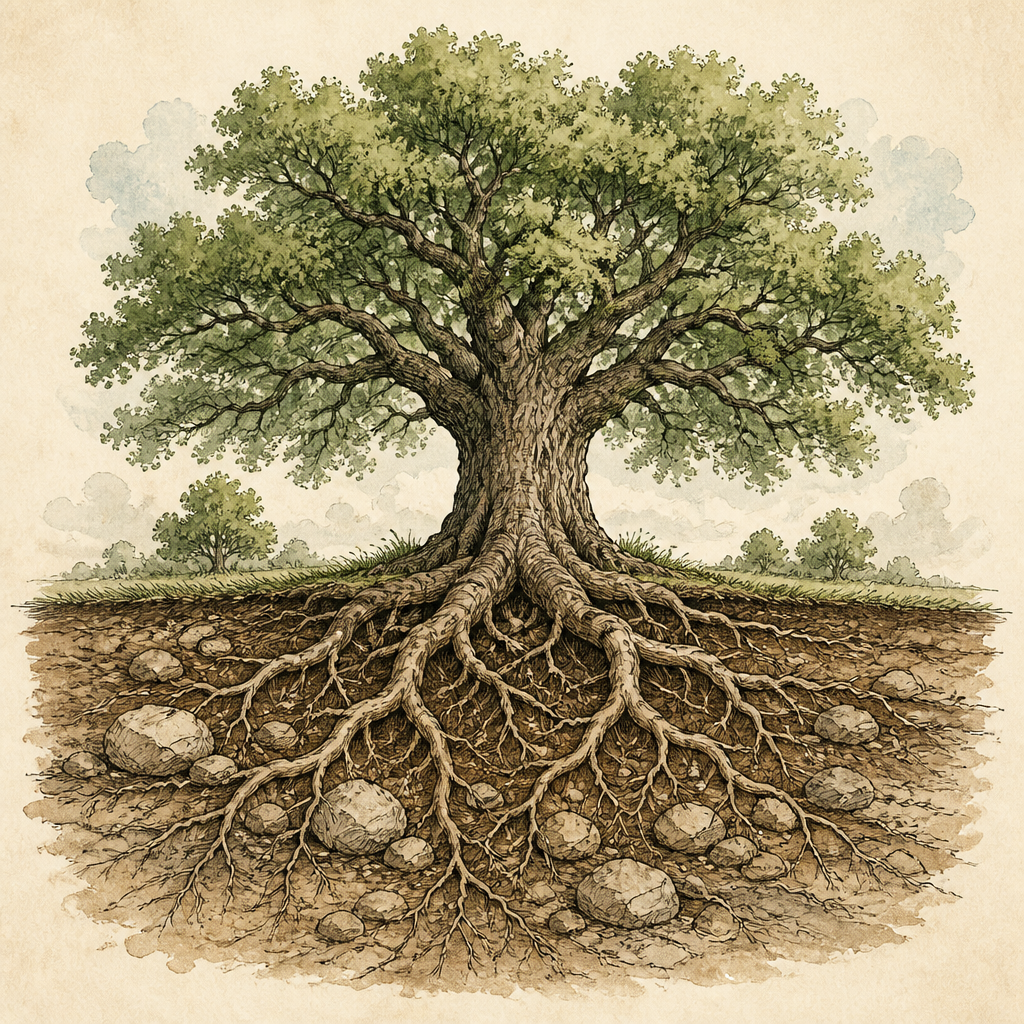
The oak does not answer to Tuesday
An oak takes eighty years to become a shade anyone can trust. A fence takes an afternoon. This week Europe is choosing between the two, and it is worth watching which one it picks.
Near Ceuta, close to a hundred people are dead or missing after chaotic crossings at the Spanish-Moroccan border. Morocco says it bears no responsibility. Ceuta's local leader calls it an atrocity and points across the frontier. In Brussels, the European Commission president says Europe needs "stronger borders." All of this is true, and none of it is new. The pattern repeats with the seasons, the same as the boat that caught fire in the Channel this week, the same as the boats before it. A crisis this recurring is not a headline. It is a structure.
And structures do not get fixed by headlines.
Fences are fast. Roots are not.
A fence answers the panic of the news cycle. It is visible by dinner, defensible on television, satisfying to a public that wants to see something done. But a fence has no roots. It does not hold the soil of trust between Rabat and Madrid, or between Madrid and Brussels, or between the twenty-seven capitals that still cannot agree who takes in whom when a boat lands. Fences are decoration for a problem that is actually structural.
What would a root look like instead? Something slower and far less photogenic: a shared asylum system that does not collapse the moment one country feels overwhelmed. Migration agreements with Morocco that survive a change of government on either side. Courts and processing centres boring enough that nobody names a crisis after them. None of this trends. All of it lasts.
Is it naive to ask for patience while people are dying at a border? No — the two are not opposites. A country still needs the short-term instinct of a fence: border guards, coastguards, functioning coast rescue, a military that can actually secure a coastline are not luxuries, they are what any grown democracy owes its citizens and the people trying to reach it. The mistake is believing the fence is the whole answer. It buys time. It does not grow trust. Only the slow institutional work does that — and Europe has spent a decade postponing the slow work in favour of the fast photograph.
What patience actually looks like
Consider, from further away, a photograph released this week of Aung San Suu Kyi — the first glimpse of her in years, offering her family, and her country's democratic movement, something to hold onto. Nobody expects Myanmar's roots to grow back by next season. Nobody sane thinks one photograph reopens a parliament. But roots survive underground exactly when nothing above the surface looks alive. That is the discipline democratic patience requires: to keep believing in the institution even when the institution is invisible, jailed, or renamed out of the news cycle altogether.
Europe's border argument could use some of that discipline. Not the discipline of pretending the crisis isn't urgent — it plainly is, and a hundred deaths near Ceuta are not an abstraction to be filed under "structural." But the discipline of refusing to let urgency substitute for institution-building. A fence announced this month will still be a fence next year. A shared asylum framework, painstakingly negotiated, will still be functioning in a decade, absorbing the next crisis instead of merely surviving it.
A question worth keeping
So here is the test for any policy announced under pressure, in Ceuta or anywhere else: if this survives the next election, the next government, the next news cycle — is it a root? If it only survives until the cameras leave — it was a fence.
Readers will not settle Europe's migration argument this week, and neither will this essay. But they can start asking the oak's question of every leader who promises safety by autumn: are you planting something, or just fencing off the view?