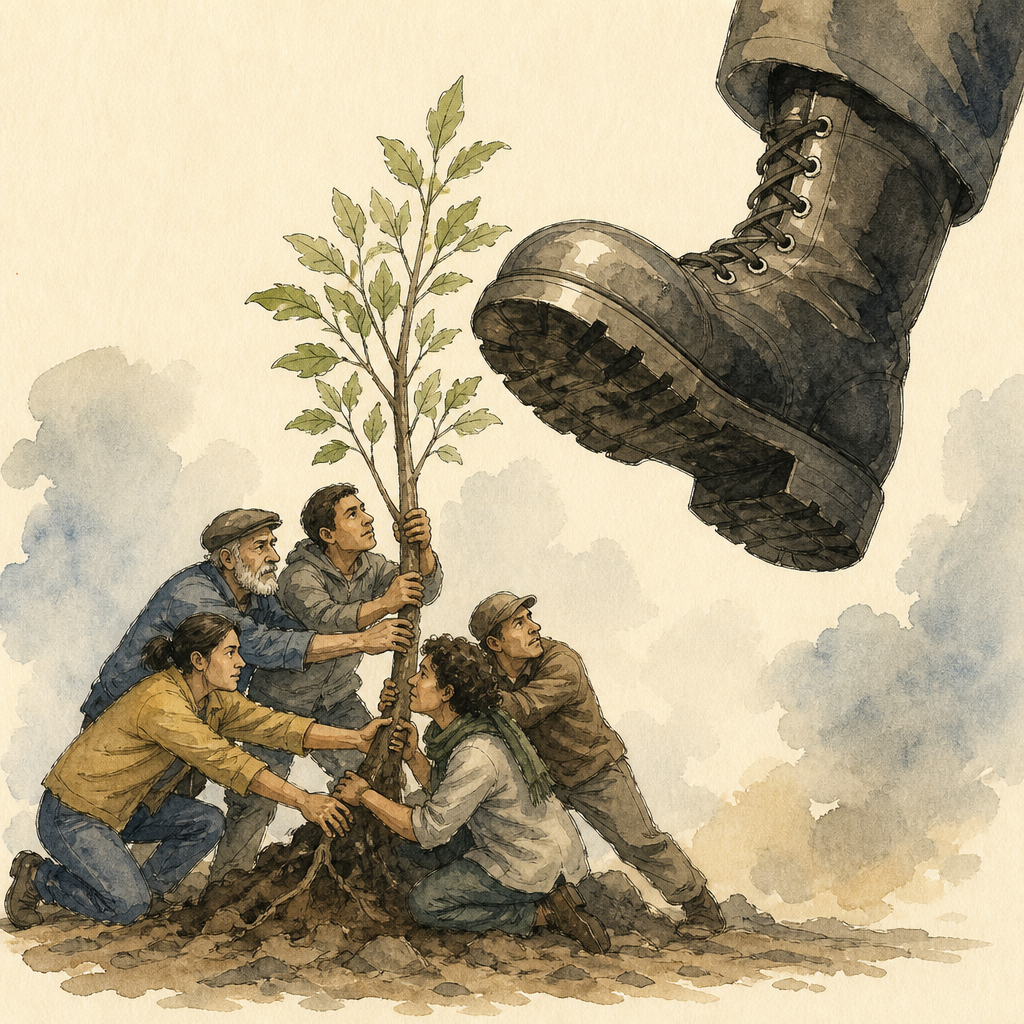
The courage that costs almost nothing
This weekend, journalists in Egypt plan to gather and ask, simply, that six of their colleagues be released from detention. It is not a revolution. It is a request, made in daylight, by people who still believe a request is a reasonable thing to make of their government.
That sentence should not sound remarkable. In a healthy civic culture, colleagues objecting to colleagues being locked up is Tuesday. The fact that it reads, in 2026, as an act of nerve tells you something about the direction things have been drifting — and it tells you this is exactly the moment to notice.
Habits of power do not announce themselves as tyranny. They arrive as convenience: a detained journalist here, a postponed trial there, a law that was supposed to be temporary. Each step is small enough to not quite warrant outrage, and large enough to normalize the next step. The Egyptian journalists planning to march this weekend are doing the single most useful thing a free citizen can do: objecting while objecting is still ordinary, before the cost of objecting becomes the story itself.
What happens when nobody did
Compare that to Ukraine this week, where strikes on civilian buses killed at least thirty people, part of a surge in attacks as winter blackouts deepen. Nobody is debating whether this is a habit anymore. It is a fully developed pattern: unaccountable power deciding, years into a war of choice, that bus queues are acceptable targets.
This is not a comparison of severity — a journalist's detention and a bus full of the dead are not the same unit of suffering. It is a comparison of timelines. Somewhere in the long run-up to full-scale invasion, there were smaller signals, smaller betrayals of international norms, smaller moments when objection was still cheap. Protest, sanctions, diplomatic pressure, clear lines — all were more possible, and would have cost less, a decade ago than they cost today, with buses burning and blackouts rationed by the hour.
This week also brought a quieter footnote to the same lesson: an American indictment accusing Venezuela's former president of torture. Indictments are a fine thing, and accountability matters even late. But notice the word former, and notice how long the gap usually runs between the habit forming and the indictment arriving. By the time the paperwork catches up to a strongman, the bill has usually already been paid by people who had no say in presenting it.
Early courage is a bargain
Here is the uncomfortable arithmetic: courage is cheapest early and most expensive late. A journalist marching for a colleague this weekend risks far less than a civilian waiting for a bus will, years into an unchecked war. A parliament asking hard questions about a minister's overreach risks far less than a population trying to unseat an entrenched regime a decade later. The whole case for early protest is not moral superiority — it is economy. Spend a little courage now, or a great deal more later, with interest.
This is also why institutional friction — South Korea recalling an ambassador over a diplomatic dispute, for instance — deserves more respect than it gets. It looks bureaucratic, almost boring, next to a drone strike or an indictment. But boring, early, institutional pushback is precisely the unglamorous machinery that keeps disputes from becoming wars and detentions from becoming disappearances.
So the useful question for readers anywhere, not just in Cairo, is not "would I protest a tyranny?" Most people would, eventually, once it is unmistakable and unbearable. The harder question is whether you would object now, while the thing being objected to is still just a habit, still small enough to look unserious, still cheap enough that objecting feels almost like overreacting.
That discomfort — the fear of overreacting — is usually the first habit worth noticing. It is remarkably similar, in every country, to the quiet feeling just before a door closes.