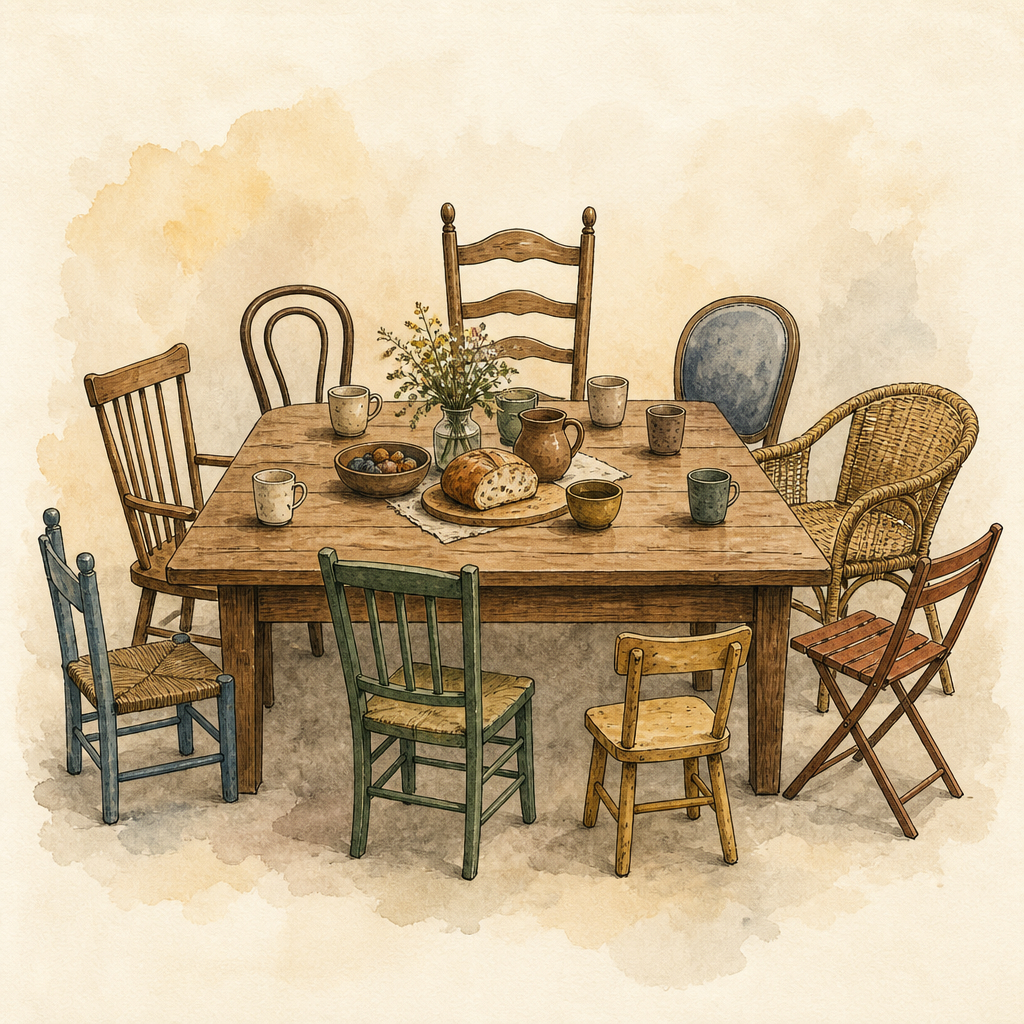
The table, and who sets it
A table is a simple thing. Someone lays it, someone is invited, someone eats. The trouble starts with the guest list.
Today's news offers three such lists, oceans apart, and it is worth reading them side by side rather than one headline at a time.
A table turned into a target
In Ukraine, people gathered at an aid centre to receive the plainest form of dignity there is: food, water, the basics that let a person remain a person through a war. Kyiv says Russian bombing killed twenty-six of them. A ceasefire elsewhere let hundreds evacuate a city before the guns resumed.
Notice the asymmetry. A pause in the fighting is treated as newsworthy mercy; a queue for bread is treated as an acceptable target. When did feeding the hungry become a military risk rather than a baseline of any decent conflict, let alone any decent peace? European governments now rehearse deploying troops to a post-war Ukraine. Rehearsal is wise. But rehearsal for what, if the lesson of today's headline is that even the simplest table — bread for the displaced — has no roof left over it?
A table with the chairs removed
In Cairo, a different kind of table was dismantled: the one where citizens compare notes on what is actually happening to them. Egypt has fined the editor Lina Attalah and shut Mada Masr, one of the country's few independent outlets. No bombs, no bodies — just a signature, and a table of public fact goes dark.
Is this smaller than a bombed aid centre? In tonnage, yes. In kind, no. Both say the same thing to the people pushed away: your presence here was conditional, and the condition has now expired. A government that cannot survive an independent editor is a government that has already decided which citizens it can do without.
A table with a disputed host
Meanwhile, Sudanese diaspora groups and human rights organisations are objecting to a nominee from the United Arab Emirates for a top UN human rights post — a country they say has fed the very war that empties Sudanese cities. If the objection holds up to scrutiny, the irony writes itself: the institution meant to guard everyone's seat at the table may be handed to someone implicated in clearing seats by force.
This is not an argument against any particular nationality holding high office — the UN needs capable people from everywhere, and suspicion-by-passport is its own kind of injustice. It is an argument for matching the résumé to the role. A steward of human rights should be someone whose record makes the job description credible, not ironic.
The table we only notice when it's ours
And then there is Ebola — "unprecedented," a health official warns, with a real chance of reaching the UK. Watch how fast concern sharpens once a crisis gains a passport stamp close to home. Africa's outbreak has been real for a while; it becomes urgent news the moment it might cross a border we recognise as ours.
That is not malice. It is simply how attention works, and it is worth admitting rather than denying. But admitting it is also the beginning of fixing it. Solidarity that only activates at the border of self-interest is not solidarity — it is risk management wearing a borrowed word.
The standpoint
Here is the simple test this newspaper would offer, Einstein's razor applied to ethics rather than physics: a seat at the table should not depend on your passport, your politics, or your proximity to someone else's fear. It should depend only on your humanity.
That test indicts the shelling of an aid queue, the shuttering of a newsroom, a compromised nominee for human rights' own table, and a world that notices suffering mainly once it travels.
None of these are abstract failures of "the international community." Each is a specific, nameable choice — a missile aimed, a fine imposed, a nomination advanced, a border watched more closely than a continent. Specific choices can be specifically protested. That is the only kind of table worth keeping.