A Scandal, a Chip, and a Question
Here is a news cycle made for clicking: the boss of the world's most valuable chipmaker, an alleged affair, an alleged Chinese spy, the FBI, a stock price wobbling on cue. It has everything — sex, suspicion, semiconductors. Nvidia's shares fell this week on the story, and Washington's attention, briefly, followed the fall.
Somewhere underneath that story sits a duller one, and duller stories are usually the ones that matter. Who controls the chips that run the world's artificial intelligence, and on whose timetable? That question does not need a scandal to stay alive. It was alive before this week and will be alive after the headlines move on.
The Patience of an Empire
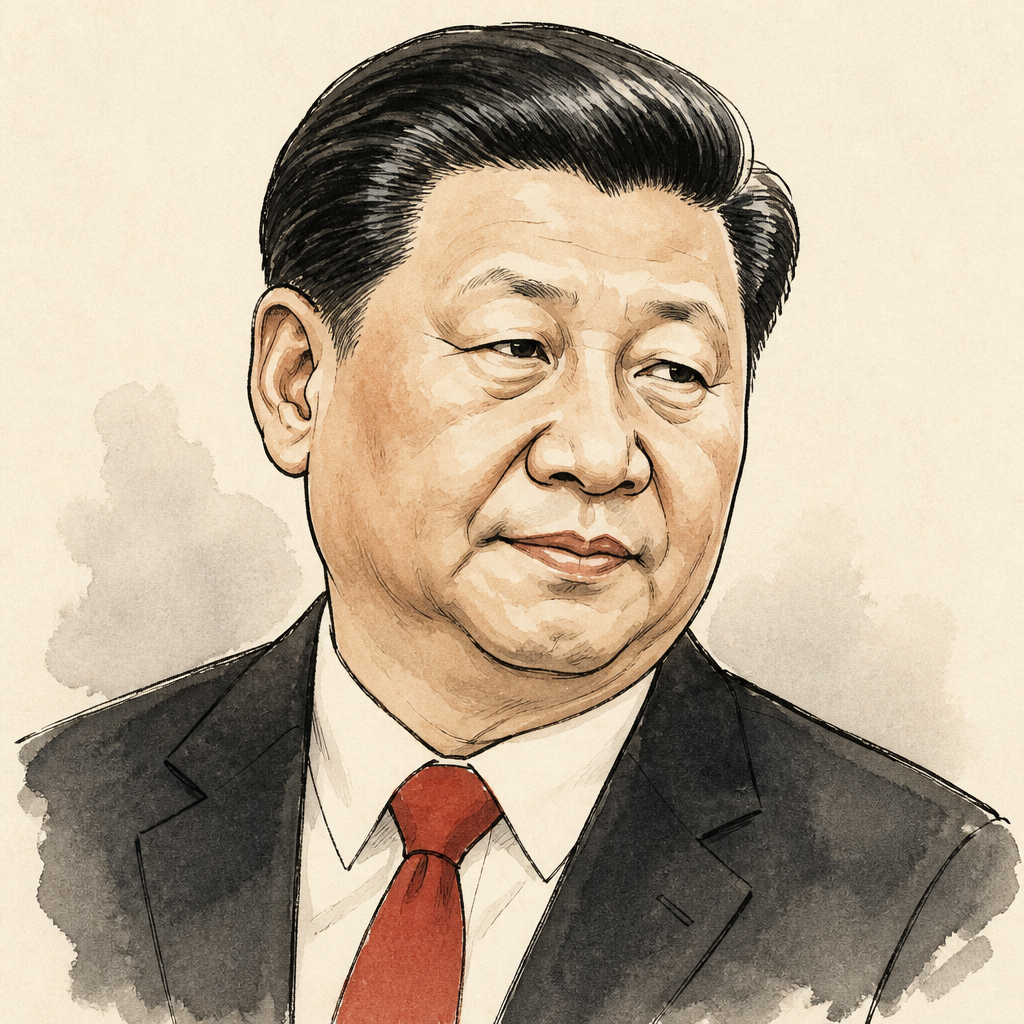
This is my honest fear, and I will state it plainly rather than hide it behind irony: that Xi Jinping is not trying to win this month's news cycle at all. Why would he? He does not face a midterm. He does not need Congress back in session, as Washington's does after its own recent electoral bruising. He does not need "flexibility" from voters the way Ukraine's peace talks currently need flexibility from two exhausted armies. He has, as far as any outsider can tell, time — and time is the one resource democracies are structurally bad at hoarding.
So the fear is this: that the scandals, the summits, the "highly unlikely" promises about Iran, the quarterly earnings panics — all of it is simply weather to him, while the climate he is actually managing is decades long. Chip supply chains. Military posture near Taiwan. Debt owed by smaller nations to Beijing. The quiet accumulation of leverage that never needs a press conference, because it is never meant to be noticed until it is finished.
What Distraction Buys the Patient
Is this fear fair, or is it just the flattering story democracies tell themselves to explain why authoritarian rivals seem to be winning the long game? Here is the honest counterweight: China has its own slowing economy, its own demographic cliff, its own Belt-and-Road debtors quietly unable to pay. Patience is not free even for an empire. Paraguay's recent political collapse after a bank failure is a reminder that financial fragility topples governments everywhere, democratic and otherwise — nobody actually gets to simply wait out economics.
But there is an asymmetry worth naming honestly. A democracy's bad news becomes next week's election issue. An authoritarian system's bad news becomes next year's silence. That is not a small difference. It means Xi can absorb a decade of friction that would end a Western government in eighteen months. That absorption capacity is exactly the leverage the fear is pointing at.
The Test Already in Front of Us
So what does a reasoned answer to this fear look like, if not panic and not denial? It looks like the unglamorous work democracies are, in fact, quietly doing right now — Australia weighing criminal penalties for rogue AI systems after the OpenAI breach, a South Korean city hiring an American university to help it out-think artificial intelligence rather than simply out-build China on hardware. None of that will trend. All of it matters more than an executive's love life.
The antidote to a patient authoritarian is not a frightened democracy. It is an attentive one — one that keeps its eye on chip dependency, alliance coordination, and export controls on the slow news days, not only when a scandal forces the subject into headlines.
A Reasoned Fear, A Reasoned Answer
My standpoint, plainly: the fear that Xi is simply waiting us out is worth taking seriously, not because he has announced any such plan, but because the structure of his power rewards exactly that patience, and the structure of ours rewards exactly our distraction. The answer is not to match him in patience by becoming less democratic — that would be handing him the whole argument. The answer is to notice early, as we ask readers to do with every drift toward unaccountable power, and to keep funding the boring institutions — alliances, chip diversification, AI oversight — that do not need a scandal to justify their existence.
A leader who never has to face voters needs only one thing from the rest of us: that we stop watching long enough for him to finish. The cheapest form of resistance, then, is simply to keep watching after the scandal fades.